
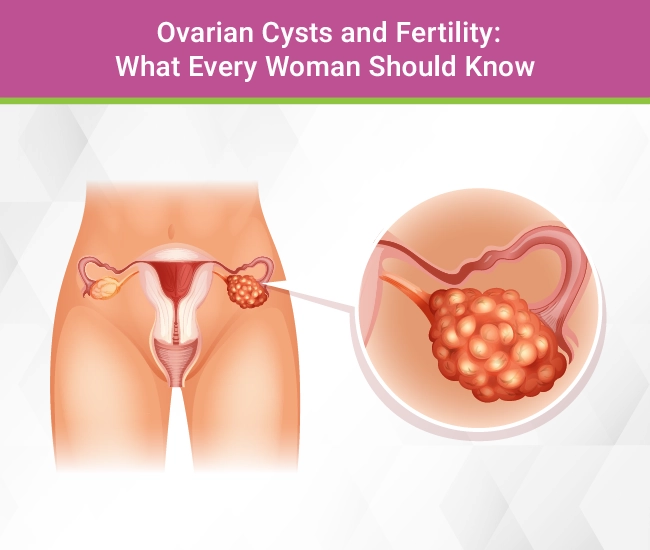
What do you do when your doctor mentions ovarian cysts in your ultrasound report? Is this a temporary change, or will it require treatment? When diagnosed with cysts, most women don’t know how to proceed further. This blog aims to explain ovarian cysts, types of common ovarian cysts, ovarian cyst sizes to be concerned about, and relevant treatment options essential for your reproductive health. Some signs that require seeking advice from a gynaecologist are also mentioned. Make informed decisions and prevent any complications from occurring in the first place.
Ovarian cysts are fluid-filled sacs/structures that form on or within the ovaries. Most people worry when they find out that they have ovarian cysts. But most of these ovarian cysts are functional cysts, which are not something you should worry about. This is because they are a part of your normal ovulation process. It’s only in rare cases that ovarian cysts are linked to ovarian cancer. Understanding other factors, such as the types and sizes, will further help you make informed decisions.
Understanding the type of ovarian cyst allows for timely medical intervention. Some common ovarian cysts include:
Follicular cysts are the most common type of ovarian cysts. They occur when a follicle does not rupture and instead keeps growing. Most follicular cysts are harmless, but they can lead to complications. This can easily be found through a pelvic ultrasound. Most of these resolve on their own and require no special treatment.
Chocolate cysts are also medically known as endometriomas. This is when the lining of your uterus grows on the ovary and bleeds with each cycle. With time, a cyst is formed, and when filled with dark brown blood, it gives a chocolate-like appearance. Similar to follicular cysts, these can be found through a pelvic ultrasound.
Most simple cysts are non-cancerous in nature, but ovarian simple cysts are specifically thin-walled, fluid-filled, and often functional or benign. Only when these cysts grow larger can they cause trouble, such as mild discomfort and swelling. In most cases, no treatment is usually required; however, your doctor can suggest an ultrasound or a CT scan.
Complex cysts have features seen on ultrasound, like solid areas, thick or irregular walls, or internal septations, often signalling higher risk than simple cysts. They may arise from conditions such as haemorrhage, infection, endometriosis, or abnormal growth, requiring prompt evaluation via imaging or blood tests like CA-125. Symptoms can include persistent pelvic pain, fever, bloating, or urinary issues; unlike benign types, they often need intervention to rule out malignancy.
Dermoid cysts are benign tumours arising from germ cells, often containing tissues like hair, skin, or teeth, and are typically present since embryonic development. They appear as well-defined cysts on ultrasound and are usually asymptomatic until larger sizes cause abdominal pain or pressure. Surgical removal via laparoscopy is common if symptomatic, with low malignancy risk.
Unlike simple cysts, malignant cysts grow aggressively and even spread to other parts of the body. Factors such as genetic mutations, abnormal cell differentiation, and rare transformation of a pre-existing cyst could be responsible for this. These cysts have poorly defined walls and lead to increased blood flow in the cyst walls. Depending on the complexity, symptoms such as fever, weakness, loss of appetite, fatigue, abdominal pain, and changes in bowel movement can be experienced.
The ovarian cyst size is one of the major factors in deciding your treatment plan. These cysts can be classified into three categories based on their size, which are:
Ovarian cysts with a size less than 5 cm are usually considered to be low risk. This is because they can develop and resolve naturally within your menstrual cycle. Active treatment for small cysts is rarely required. An ultrasound after a few months can be suggested by your gynaecologist.
Medium cysts between 5 and 7 cm often require close monitoring when compared to ovarian cysts in smaller sizes. With medium cysts, concerns such as pelvic pain, bloating, or discomfort become quite common. Intervention for pain relief is suggested in many instances.
Unlike small and medium-sized cysts, these require proper medical evaluation. Women with large cysts may report concerns such as severe abdominal pain, bloating, the urge to frequently urinate or even constipation. In certain cases, complications such as ovarian torsion and cyst rupture can occur.
Treatment of ovarian cysts is based on the cyst type, size and nature of the cyst. The goal of the treatment here will be focused towards your ovarian health. Here are some treatment options that are generally recommended:
Medications are often prescribed if the cysts are due to hormonal issues or endometriosis. Pain relief or hormonal medications can be prescribed based on your symptoms. These medications reduce the chance of recurring cysts and are usually considered safe when used under supervision.
When observation and medication do not work, surgical options are often recommended for ovarian cysts. Some common types of surgery include:
Some cysts require medical attention; some may resolve on their own. In order to avoid complications, it’s suggested you seek advice from a gynaecologist in the following cases:
With advancements in surgical procedures such as laparoscopy and open surgery, treatment of conditions such as endometriosis and ovarian cysts is much easier. The more time you leave your condition untreated, the higher the chances of complications. Small to medium cysts can be treated with observation and medications alone. Contact us to get a better understanding of your symptoms and treatment options. With 20+ years of experience, Dr. Shreya Prabhoo is one of the best gynaecologists practising in Mumbai. Her associations and memberships with several organisations are a testament to her medical excellence.
 Dr. Shreya Prabhoo (MBBS, DGO, DNB, MRCOG, FICOG, MNAMS) is a highly respected Consultant Obstetrician and Gynecologist based in Mumbai.
Copyright © 2026. All Rights Reserved. Made By Capsicum.
Dr. Shreya Prabhoo Technical Support
Need guidance on women’s health, pregnancy, or gynecology treatments?
Chat with Dr. Shreya’s team on WhatsApp for appointment booking and expert advice.
WhatsApp Us
🟢 Online | Privacy policy
WhatsApp us