
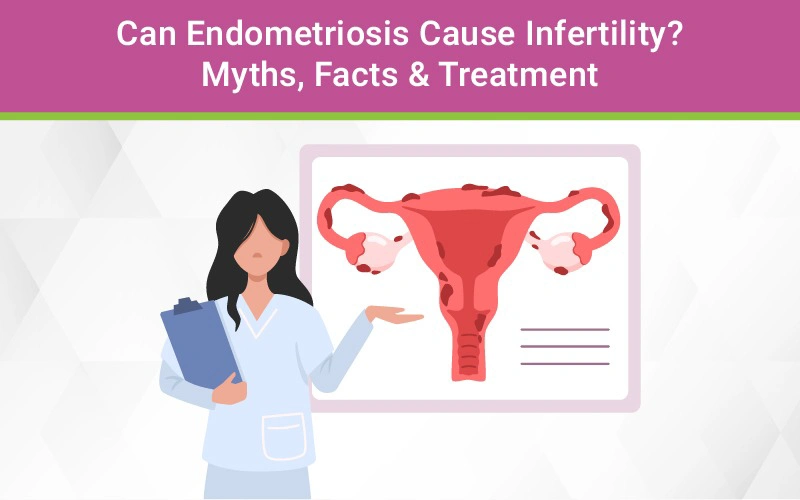
Do you also think endometriosis can affect your chances of fertility? Due to their complex connection, there are several myths surrounding this topic. This blog aims to decode several myths regarding infertility, pregnancy, severity and more. But before that, we’ll help you understand this medical condition, its symptoms, causes, risk factors, and various methods used for diagnosis. Effective treatment options, such as surgery, IVF, and pain relief medications, are also provided. Some vital steps to prevent the progression of endometriosis are also given. With all this information, you’ll surely be able to make an informed decision.
Endometriosis is a medical condition in which tissue similar to the uterine lining grows outside the uterus. In each menstrual cycle, this tissue thickens and breaks down as it has no natural way to exit the body. And while endometriosis can commonly be found in the pelvic region, it can also be seen in the fallopian tubes, the outer surface of the uterus, and the pelvic lining.
Most women don’t even recognise the common endometriosis symptoms, as they mistake them for digestive troubles. Recognising the early symptoms allows for early intervention. Here are certain symptoms related to your menstrual cycle that point towards endometriosis:
There is not a single cause that can be linked to endometriosis. A combination of biological, hormonal, genetic and immune-related factors is often responsible for this condition. Let’s try to understand some of these factors in more detail:
The connection between endometriosis and infertility is quite complex. The chronic inflammation makes it more difficult for the egg and sperm to implant. In some cases, it also raises concerns about ovulation and egg quality. It’s important to recognise that the severity of endometriosis might not necessarily correlate with the fertility outcomes. Today, several myths are present that might create unnecessary fear. With timely diagnosis and the right support, including personalised infertility treatment, many women are still able to conceive successfully.
There are several ways of diagnosing endometriosis. This is because the symptoms may not present in the same way. Proper clinical judgement and even surgery are required in some cases. Let’s understand a few of these in more detail:
Managing endometriosis required a personalised approach. There is no set treatment that can work for everyone. The goal here is not just symptom relief but also ensuring the patient’s long-term well-being. Here are some effective treatment options we recommend:
Medications play a key role in regulating your hormonal activity. Pain relief medication could be given to manage menstrual cramps. Hormonal medications, on the other hand, are useful to stabilise hormonal fluctuations. The choice of medicines prescribed by your doctor depends on the chosen treatment method.
The aim of surgical treatment for endometriosis is not to either remove or destroy the endometriotic tissue. Minimally invasive techniques such as laparoscopy are commonly preferred for endometriosis. These allow for the removal of adhesions, lesions and cysts while still preserving your fertility. Careful surgical planning is required for the surgery to become successful.
IVF is an excellent option for individuals having trouble conceiving due to endometriosis. For mild cases, consider IUI after laparoscopic surgery; IVF excels for moderate-to-severe stages, often post-excision, to address pelvic inflammation, distorted anatomy, or blocked fallopian tubes while optimising success rates.
Consult your doctor if you have any queries regarding these fertility-preserving approaches.
If not managed, endometriosis can worsen with time. Early recognition can help to reduce long-term complications. A proactive approach is recommended that is based on diagnosis, an anti-inflammatory diet, yoga and more. Let’s try to understand these in more detail:
Recognising early symptoms is among the most supportive strategies. Consult your doctor if you recognise any of the warning signs mentioned earlier. Instead of delaying your treatment, seek prompt medical evaluation whenever required.
A diet rich in fruits and vegetables will help to naturally reduce inflammation levels. Healthy fats in the form of flax seeds, walnuts, and fatty fish can be added for the same purpose. For noticeable results, try limiting sugary and processed foods.
Yoga is a powerful ancient technique useful for pain relief and stress reduction. Certain yoga poses, such as cat-cow pose, child’s pose and cobra pose, are often recommended for a better hormonal balance. Yoga is a non-invasive way that helps to treat underlying stress and inflammation concerns.
Endometriosis is a complex medical condition that often requires a long-term treatment approach. Understanding its symptoms and cause is the first step. Through this blog, we’ve tried explaining all the vital myths and facts you need to be aware of. Proper diagnosis and guidance from an expert are what will ultimately help to treat endometriosis. Both surgical and non-surgical treatment options can be suggested based on the complexity of your symptoms. Contact us if you believe in a holistic approach to treating endometriosis. At Dr. Shreya Prabhoo, we provide personalised treatment only after a detailed evaluation of your symptoms. Right from minimally invasive laparoscopy procedures to advice on diets and exercise, we will take care of all your concerns.
 Dr. Shreya Prabhoo (MBBS, DGO, DNB, MRCOG, FICOG, MNAMS) is a highly respected Consultant Obstetrician and Gynecologist based in Mumbai.
Read More
Dr. Shreya Prabhoo (MBBS, DGO, DNB, MRCOG, FICOG, MNAMS) is a highly respected Consultant Obstetrician and Gynecologist based in Mumbai.
Read More
Copyright © 2026. All Rights Reserved. Made By Capsicum.
Dr. Shreya Prabhoo Technical Support
Need guidance on women’s health, pregnancy, or gynecology treatments?
Chat with Dr. Shreya’s team on WhatsApp for appointment booking and expert advice.
WhatsApp Us
🟢 Online | Privacy policy
WhatsApp us