
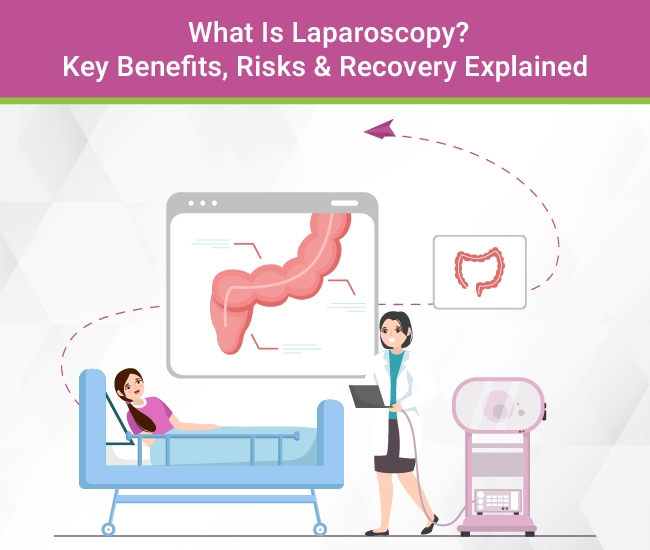
So your doctor has recommended that you undergo a laparoscopy procedure. But what does it actually mean? Do you resume your daily activities quickly? Will this be safe or risky? Which type of laparoscopic surgery should you go for? This blog aims to provide you with detailed information so you can take the right steps towards your healing journey. We’re sure that towards the end, you’ll be able to decide whether you should go for a laparoscopy or a traditional surgery. Evaluate the benefits against the risks and feel informed and confident before you undergo this procedure.
Laparoscopy is a minimally invasive surgical procedure used for several gynaecological and abdominal conditions. The procedure starts with a small incision through which a camera is inserted that allows a clear image of your internal organs. Most patients feel comfortable resuming their daily activities within 2-3 days. An experienced doctor is usually required to lower risks such as bleeding, infection or organ damage.
Different types of laparoscopy can be suggested based on your treatment goals. Some commonly suggested laparoscopies fall under two categories, which include:
Diagnostic laparoscopy helps to understand the reason behind your symptoms. Diagnostic laparoscopy is a type of minimally invasive surgical procedure. In this surgery, the surgeon creates small incisions to examine the region around the ovaries, fallopian tubes, uterus and others. This treatment is usually done for the diagnosis of endometriosis. The recovery period of this procedure lasts less than a week.
Operative laparoscopy involves the creation of small incisions in your abdomen through which special instruments are used for treatment purposes. Operative laparoscopy is often recommended when medicines fail to work. Minimal scarring, less pain, reduced risk of blood loss, and a shorter hospital stay are often some of the reported benefits.
Laparoscopic myomectomy is a procedure that helps to remove fibroids while still preserving your fertility. This type of laparoscopic procedure is usually done with patients who do not respond well to medications. An experienced surgeon will help you with fibroid removal while minimising the risk of internal bleeding. Patients often experience relief from pelvic pain or heavy bleeding.
This procedure is considered the last form of treatment by many women. This is because it can involve the complete removal of your uterus. The recovery period for this procedure is 2 weeks, with a hospital stay consisting of 1-2 days. An important thing to note is that your period will stop permanently after this procedure.
Laparoscopy for ovarian cysts is a minimally invasive surgical procedure used for the removal of ovarian cysts. This procedure is usually prescribed after the cysts do not go away with medicines. The procedure involves the surgeon creating small incisions through which a laparoscope is inserted. Special instruments are then used for the removal of the cysts. A key advantage of this procedure is that it does not affect your fertility.
Like diagnostic laparoscopy, laparoscopy for endometriosis is yet another minimally invasive surgical procedure. This procedure is used for diagnosing and treating endometriosis. The best part about this procedure is that it can be done in a single setting. After treatments, most patients often report benefits such as reduced pelvic pain, less painful periods and better quality of life.
For more information, it’s advisable that you speak to a doctor. An experienced doctor will reduce the risk and ensure a quick recovery period. Consult Dr Shreya Prabhoo, a trusted laparoscopy doctor in Andheri, if you’re looking for treatment of laparoscopy or hysteroscopy.
Unlike traditional surgeries, laparoscopic surgery ensures a quicker healing process. Here are some other benefits of laparoscopic surgery:
Instead of a single large cut, multiple tiny incisions are created in laparoscopic surgery. This significantly lowers the risk of a wound infection. Chances of tissue damage get reduced significantly, and there is a low risk of blood loss. The healing period here is usually faster, and the chance of developing an incisional hernia is also on the lower side.
Laparoscopy offers better surgical precision when performed by an expert. Abnormalities that may not be possible to see with the naked eye during open surgery become easily noticeable due to the panoramic view. The affected tissue is easily distinguishable from other healthy structures. The natural anatomy is preserved here, which is great for long-term reproductive health.
As this procedure makes use of small incisions, there is less trauma to the surrounding tissues. As there is less handling of the tissue, the organs remain closed and safe from infections. A key benefit of laparoscopic surgery is that it prevents adhesion formation. This further prevents the impact on your fertility in the ovary and fallopian tubes.
With laparoscopy, most patients are able to resume tasks such as walking and eating quite soon. Even reliance on pain medications is usually on the lower side, unlike traditional surgeries. A hospital stay of only 1-2 days is required. This enables them to return to their work responsibilities quite quickly.
While risks that arise due to laparoscopic surgery are on the lower side, there are still certain complications that could happen. These include:
Complications such as heavy bleeding, swelling, abdominal pain, damage to vessels, or the uterus can occur. This requires assistance from a skilled surgeon. Chances of complications such as a hernia at incision sites can also increase.
Abdominal bloating is a common side effect observed after surgery. You may also experience abdominal pain. This usually will subside in 2-3 days. Gentle exercises, drinking warm fluids and eating easily digestible foods are a few ways to relieve discomfort.
Mild side effects such as nausea, dizziness, sore throat and headache are still alright when compared to allergy or breathing concerns. In most cases, the anaesthesia team takes care of any concerns related to breathing. Patients with asthma, sleep apnoea, or related lung issues need to be extra careful.
Recovery time after laparoscopy depends on many factors. Some of these factors are:
Diagnostic laparoscopy has a shorter recovery time of 1-2 days compared to operative laparoscopy procedures, which might require 2 weeks.
Younger individuals have a better immune system, due to which their recovery process is usually faster. With time, this will tend to slow down, with the recovery time being longer.
With a protein-rich diet, your body is generally able to heal faster. Not just diet, you also need to take care of your hydration levels. Adding fibre-rich foods is another tip we can give. For more diet suggestions, we recommend you read this blog on foods to eat and avoid during periods.
Pre-existing medical conditions such as diabetes, anaemia, thyroid, blood pressure, or heart disease can further increase certain risks.
While the benefits of laparoscopic surgery outweigh its risks, you should still seek guidance from an expert. With less scarring, small incisions, short hospital stays and other factors, laparoscopy remains a preferred choice when compared to traditional surgeries. With extensive experience, Dr Shreya Prabhoo is a trusted gynaecologist in Andheri East who specialises in laparoscopic surgery. Our services consist of not just treating laparoscopy but also pelvic pain, fibroids, PCOS, and heavy periods, among others. Contact us to receive personalised guidance for women’s health care.
 Dr. Shreya Prabhoo (MBBS, DGO, DNB, MRCOG, FICOG, MNAMS) is a highly respected Consultant Obstetrician and Gynecologist based in Mumbai.
Read More
Dr. Shreya Prabhoo (MBBS, DGO, DNB, MRCOG, FICOG, MNAMS) is a highly respected Consultant Obstetrician and Gynecologist based in Mumbai.
Read More
Copyright © 2026. All Rights Reserved. Made By Capsicum.
Dr. Shreya Prabhoo Technical Support
Need guidance on women’s health, pregnancy, or gynecology treatments?
Chat with Dr. Shreya’s team on WhatsApp for appointment booking and expert advice.
WhatsApp Us
🟢 Online | Privacy policy
WhatsApp us